See schedule for times and locations.
Opening Keynote:
Dr. Jon Corbett
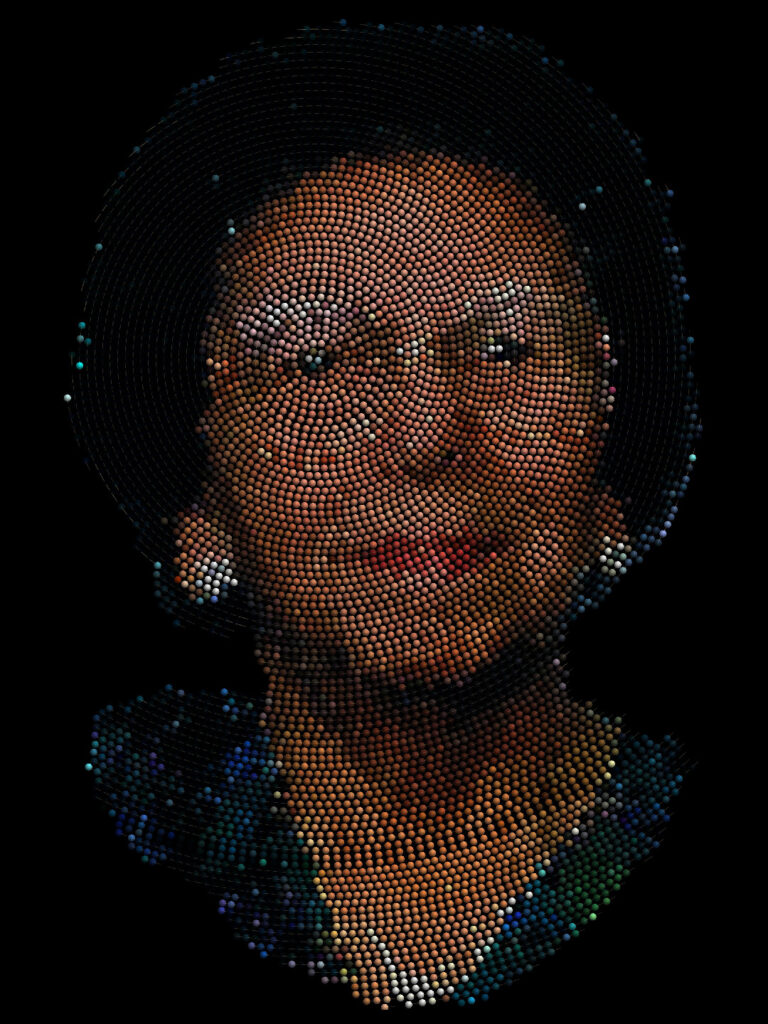
Re-enchanting the Pixel through Digital Kinship and Electric Spirit Berries
For decades, computer graphics has operated under a “bad habitus” of applying colonial logic and the Cartesian grid, which flattens complex, relational worldviews into discrete, extractive data points. This talk traces a decades-long journey of computational resistance, beginning with the pixel’s ancient origins in celestial “constellations” and culminating in a practice of Indigitalization.
By reframing the pixel as a manidoomin (spirit berry), we move beyond Western formalist models of point, line, and plane toward a framework of Digital Kinship. This talk demonstrates how intentionally “breaking” programmatic efficiency by replacing linear loops with cyclical spirals and addressable grids with relational structures can transform understandings of digital visual representations into a site for Indigenous and ancestral survivavnce and cultural continuity.
We will explore how Indigenous epistemologies can reorient the future of multimodal research, challenging the graphics community to look beyond optimization. How might our systems change if we treated technology not as a neutral tool but as a relative? This session offers a path toward “re-enchanting” our digital canvases, asserting that the future of the interface lies in its capacity to sustain rather than extract and to remember rather than erase.
Bio
Dr. Jon Corbett is an Assistant Professor with Lived Indigenous Experience in the School of Interactive Art & Design at Simon Fraser University, with a background in art, design, and computer programming. He holds degrees from the University of Alberta and the University of British Columbia. Corbett’s research explores Indigenous digital expression through a decolonial lens, focusing on developing computational models of Indigeneity that reflect culture, kinship, history, and land relations.
His work includes creating a nehiyaw-based (Plains Cree) programming language, designing hardware for syllabic orthography, and developing software that uses Indigenous storytelling. Corbett’s artwork has been exhibited worldwide and featured at the Smithsonian’s National Museum of the American Indian in New York City, NY, and at the Contemporary Native Art Biennial (BACA) in Montreal, QC.
Closing Keynote:
Dr. Fanny Chevalier
Cues, Not Commands: Designing for Intent Beyond the Prompt
Imagine you are collaborating with a colleague on a design. As you discuss layout, colour, and content, neither of you speaks in precise instructions. Instead, you sketch loosely on a whiteboard, gesture through possible arrangements, and articulate half-formed ideas as they come to mind, sometimes leaving things deliberately ambiguous, sometimes clearly articulating constraints. The explanation is fragmented, evolving, and often imprecise, yet punctuated by a few specific, fixed, non-negotiable elements. When your colleague pauses and asks, “you see what I mean…?“, you nod. From these fragments, you’ve grasped the intent, the big picture, and can move the idea forward.
This scenario illustrates a distinctive human ability: we are remarkably good at making sense of incomplete, multimodal, and approximate information. We infer intent, fill in gaps, and extrapolate beyond what is explicitly said, while respecting constraints and staying within an intended direction. With the rise of generative AI, the vision of interacting with computers in this way has become more tangible. From a loosely expressed idea, even a ramble, systems can now generate images, text, and structure. Interaction is increasingly reframed as conversation.
And yet, this shift exposes a tension. Traditional computing systems have long relied on instruction-driven interaction: rigid, precise, and controllable, but overly literal, doing exactly what is specified and nothing more. AI-powered conversational input, on the other hand, creates the illusion that intent can be directly expressed and faithfully realized. In practice, we are still forced to spell out details, by expanding and refining prompts through low-level textual instructions to maintain control over the things we had in mind.
In this talk, I argue that we are not lacking better prompts; we are missing forms of interaction that offer high control while embracing underspecification and ambiguity. The answer is not to shift traditional input toward open-ended conversational modes, but to rethink the nature of interaction itself, beyond operation-level instructions. Operation-level instructions give us precision and control, but they capture only part of what we mean. The real challenge is to elevate them into forms that express both exact specifications and intent.
Focusing on creative domains such as drawing, sketching, and writing, I will show how intent can be expressed through augmented, non-conversational inputs and tools that preserve strong authorial control while leveraging the automation and generative capabilities of modern computing. These approaches move push interaction beyond instruction-following, towards intent, embracing emergence rather than merely executing deterministic commands for computationally-supported creativity.
Bio
Fanny Chevalier is an Associate Professor in Computer Science and Statistics at the University of Toronto. Her research lies in Human–Computer Interaction and Information Visualization, focusing on the design, implementation, and evaluation of interactive tools for visual analytics and creative activities, particularly for exploring complex data and supporting creative workflows. Prior to joining the University of Toronto, she was a research scientist at Inria, France. She obtained her PhD in computer science from the Université de Bordeaux in 2007. She has authored over 100 peer-reviewed publications and received more than 20 best paper and honourable mention awards at IEEE VIS, ACM CHI, and ACM UIST. She served as Award Chair for ACM CHI 2022 and IEEE VIS 2020 (Short Papers), and as Program Chair for ACM UIST 2020 and ACM ISS 2020. In 2023, she was named a Knight in the Order of the Academic Palms by the French government in recognition of her contributions to education and culture.